Modernize Education
Develop and implement modernized, internationally recognized OSH curricula and e-learning resources tailored for the mining sector in partner countries.
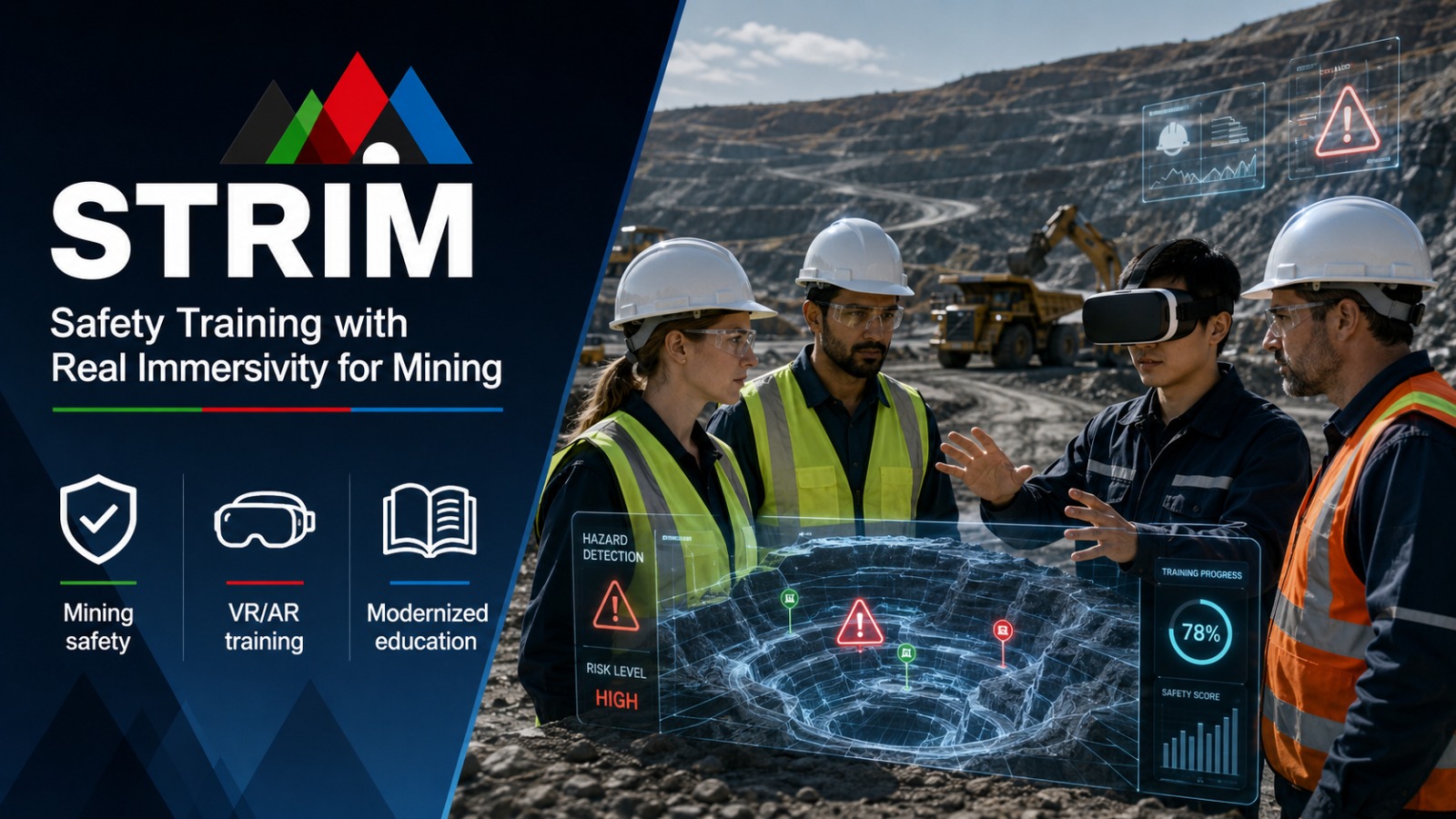
Safety Training with Real Immersivity for Mining (STRIM) arises from the synergy between higher education institutions and mining companies providing tools to improve occupational health and safety (OSH) conditions and implementation of coherent and comprehensive educational approaches for the mining sector.
Mining, while vital, remains one of the most dangerous sectors, often carrying a negative image. Accidents incur significant costs, affecting individuals, companies, and society. The STRIM project addresses this by developing innovative training methods using Virtual and Augmented Reality (VR/AR) to simulate mining environments safely. Our goal is to enhance Occupational Safety and Health (OSH) through modernized educational programs, smart technologies, and capacity building in universities, fostering a strong safety-oriented culture.
Develop and implement modernized, internationally recognized OSH curricula and e-learning resources tailored for the mining sector in partner countries.
Integrate VR/AR technologies and risk analysis systems to create realistic, safe training environments for simulating mining scenarios and hazards.
Foster collaboration and capacity building through international mobility, a shared web platform, and accessible training resources for students and professionals.
From understanding real mining risks to safer operations — our four-step immersive training approach.

Both STRIM training courses — OSHTP and AOSHTP — are available online on the e-learning platform, with lessons, resources and certification.

01 July 2026
The STRIM project's final events — the 3rd Webinar and the International Conference — take place on 28 and 29 July 2026. Registration is open and free.
Read more →11 February 2026
STRIM took part in the International Day of Women and Girls in Science conference, with a talk on female leadership in national and international projects.
Read more →November 2025
STRIM joined the commemorative events of Angola's 50th independence anniversary to increase the project's visibility and disseminate its innovations in occupational safety and health.
Read more →
This project has received funding from the European Union's Erasmus+ Programme (ERASMUS) programme under grant agreement No 101083272.
